
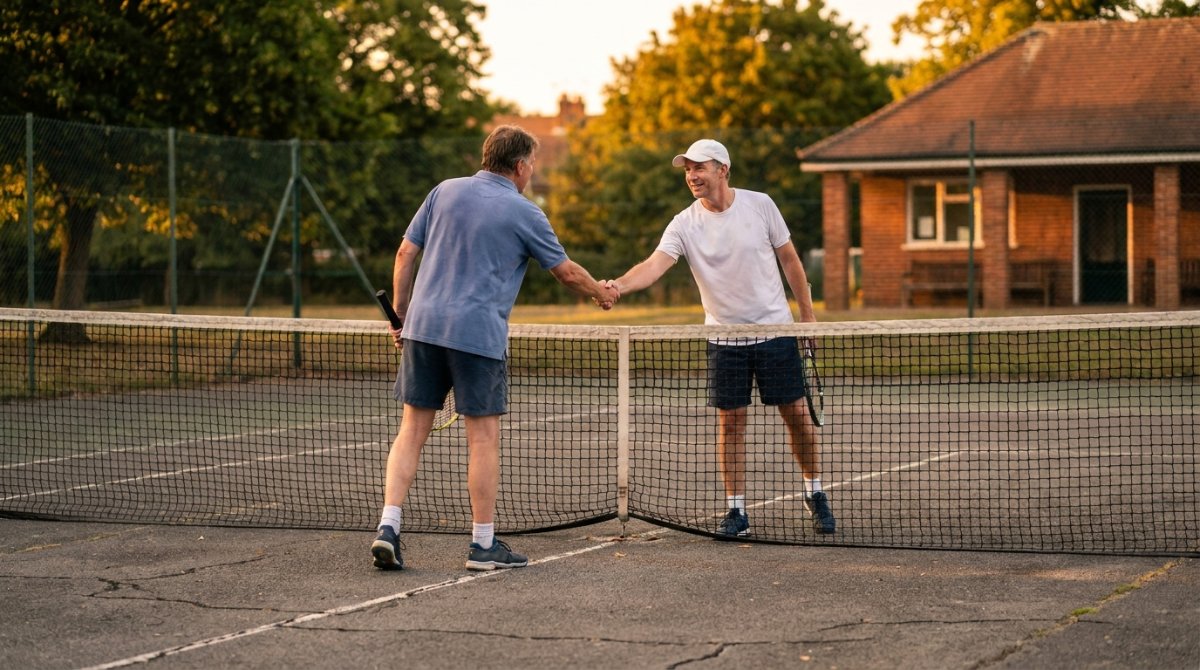
Tennis etiquette boils down to one principle: don’t cost anyone else their game. Wait for a point to finish before walking behind a court. Call your own lines honestly and your opponent’s balls “in” when in doubt. Return stray balls to the server, not vaguely in their direction, and never mid-point. Keep the score audible before every serve. At a public park court, arrive on time and leave on time, overrunning your booking is the cardinal sin of British park tennis. None of it is complicated; all of it is noticed.
Key Takeaways
- Doubt = in. If you’re not certain a ball was out, it was in. That’s the rule, not just the courtesy.
- Never cross behind a live point. Wait at the fence until the rally ends, then walk briskly.
- Server announces the score before every point, it prevents 90% of disputes before they exist.
- Return balls to the server (a catchable feed), and only between points.
- Warm-ups are for both players: hit to your opponent for five minutes, don’t practise winners at them.
- Park courts: start on time, finish on time, take your balls and bottles with you.
Tennis has an official rulebook, and then it has the real rulebook: the unwritten code that separates the player everyone wants to hit with from the one nobody rebooks. Nobody hands you this at the gate of your local park court, and most club members learned it through a decade of small embarrassments.
Consider this that missing handbook. Whether you’re stepping onto a court for the first time (our beginner’s guide to tennis covers the actual rules) or joining your first club box league, here’s how to play like you belong, because etiquette, unlike a kick serve, can be learned in an afternoon.
Part 1: Arriving and Leaving
Book it, make it, end it on time
On Britain’s park courts, the booking slot is sacred. Arrive five minutes early so you’re playing at the top of the hour, and. This is the one people get wrong, stop when your time ends, even mid-game. The pair waiting at the gate don’t care that it’s 5–5. If courts are free either side of you, nobody minds you carrying on; if people are waiting, wrap it up on the hour, every time. The LTA court finder lists every bookable park court in Britain.
Crossing courts
Never walk behind a court mid-point, not quickly, not apologetically, not “just this once”. Wait at the fence until the rally finishes, then cross promptly behind the baseline. If you must cross several courts, wait for a natural break and move through in one go.
Leave no trace
Take your ball tubes, bottles and grip wrappers with you. A court you leave scattered with rubbish is a court someone else has to clean before playing.
Part 2: The Warm-Up
The five-minute knock-up before a match has its own micro-etiquette:
- Hit to your opponent, not past them. The warm-up is cooperative. You’re both trying to get loose. Ripping winners off their gentle feeds marks you out immediately (and warms up nothing).
- Offer volleys and smashes. A standard warm-up: baseline rally, then each player takes net for volleys and a couple of smashes, then serves.
- Warm up serves from both sides, and return warm-up serves to the server, not for a winner.
- Keep it to 5–10 minutes unless you’ve both agreed otherwise.
Part 3: Calling Lines. The Honesty Economy
In everything below professional tennis, players call their own lines. The entire sport runs on this honesty economy, and its central law is beautifully simple:
If you are not sure the ball was out, it was in.

Not “probably out”. Not “I think it caught the line”. The benefit of every doubt goes to your opponent. That’s the actual code (it’s written into the LTA and ITF guidance on unofficiated matches), and it’s also how you keep opponents for years.
The supporting rules:
- Call immediately and audibly. “Out” called two shots later doesn’t count, play continues.
- You call your side only. Don’t call balls on your opponent’s side of the net, and don’t ask spectators to adjudicate.
- Overrule yourself in their favour if you realise your call was wrong. It’s one of the classiest moves in tennis.
- Never “make up” for a bad call with a deliberate miss, two wrongs just muddle the score. Correct the call itself if you can; otherwise move on.
Scoring disputes
The server should announce the score clearly before every point. It’s the cheapest dispute-prevention system ever invented. If you do disagree, go back to the last score you both agree on and replay from there. No shouting match in history has ever retrieved a lost point.
Part 4: Ball Management
- Return balls to the server as a catchable feed: rolled to their hand or bounced gently to them. Whacking balls vaguely toward their back fence and making them fetch is quietly infuriating.
- Only between points. Never send a ball back while a point is being played on your court or the next one.
- Ball on your court from next door? Wait for both points to finish, then return it to the server on that court with a friendly “thanks”.
- Your ball rolls onto a live court? Call “sorry, ball!” once, so they can stop safely, and wait for it to come back. Don’t chase it through their rally.
- Call a let if a stray ball interrupts your point: replay the whole point, first serve.
Part 5: Noise, Phones and Celebrations
- Talk between points, not during them, and keep coaching-from-the-sideline out of other people’s matches entirely.
- Phone on silent, in your bag. Answering a call mid-set is a statement, and not a good one.
- Celebrate your winners, not their errors. A fist pump after a great passing shot is sport; cheering a double fault is not.
- Grunting: within reason it’s part of tennis. Theatrical noise designed to distract is gamesmanship, and everyone can tell the difference.
Part 6: Doubles Etiquette
Doubles adds a partner to be decent to:
- Mistakes are shared. “My fault” and “good idea, wrong execution” keep partnerships alive; visible sighs end them.
- The receiver’s partner calls the service line: it’s their line to see. Serving team calls nothing on the far side.
- Communicate before points (“I’ll take the middle”), not during your partner’s swing.
- At club social sessions, rotate fairly: the strongest pair splitting up for the next set is standard courtesy.
Coaching principle: etiquette is tactical. Players who call lines fairly, keep score audibly and stay composed get invited back, get the benefit of the doubt on close calls, and spend their energy on tennis instead of grievance. Manners are a competitive advantage.
Part 7: Spectating and Waiting
Waiting for a court? Stand back from the fence rather than looming over the baseline, and resist commentary. Watching a friend’s match? Applaud good points from both players; tennis crowds, even a crowd of one at a park in Leeds, clap winners, not errors.
FAQ
What is the “when in doubt, call it in” rule?
It’s the core principle of self-officiated tennis, written into ITF and LTA guidance: a player may only call a ball out if they clearly saw space between the ball and the line. Any uncertainty means the ball is good. Guessing “out” isn’t a judgement call. It’s cheating, even when it’s accidental.
Can I walk behind a court while a point is being played?
No, wait at the side until the rally finishes, then cross briskly behind the baseline. Walking behind a live court is the fastest way to earn a court full of glares, and it’s genuinely distracting for players mid-point.
Who calls the lines in a friendly tennis match?
Each player (or team) calls the lines on their own side of the net. You should also call your own serves’ faults if you see them clearly, and correct any call you realise you got wrong, in your opponent’s favour.
What happens if we can’t agree on the score?
Return to the last score both players agree on and replay from there. The habit that prevents this entirely: the server announces the score before every single point.
Is grunting bad etiquette in tennis?
Natural exertion noise is fine. It’s part of the modern game. Deliberately loud or timed noise intended to distract an opponent crosses into gamesmanship, and under the rules a genuinely distracting deliberate noise can even cost the point (a “hindrance”).
What should I do if a ball from another court rolls onto mine?
Stop the point safely by calling a let, wait until the neighbouring point has also finished, then return the ball to the server on that court. Replay your point with a first serve.
What’s the etiquette for park courts vs private clubs?
The code is identical, honesty, noise, ball management, but park courts add strict time-keeping (start and finish exactly on your booking) while clubs add local customs: mixing in at social sessions, rotating fairly, and dress codes that are worth checking before your first visit. Our guide on what to wear on a tennis court covers that side.
Should beginners apologise for bad shots?
Once per shanked ball into the next postcode is plenty, and never for winning a point. Apologising constantly slows the game and makes rallying partners uncomfortable. The traditional exception: the apologetic hand-raise when you win a point off the net cord.
Final Thoughts
Every rule above compresses into one sentence: play as if you’d happily be your own opponent. Do that and any club or park in Britain will be glad to see you back.