
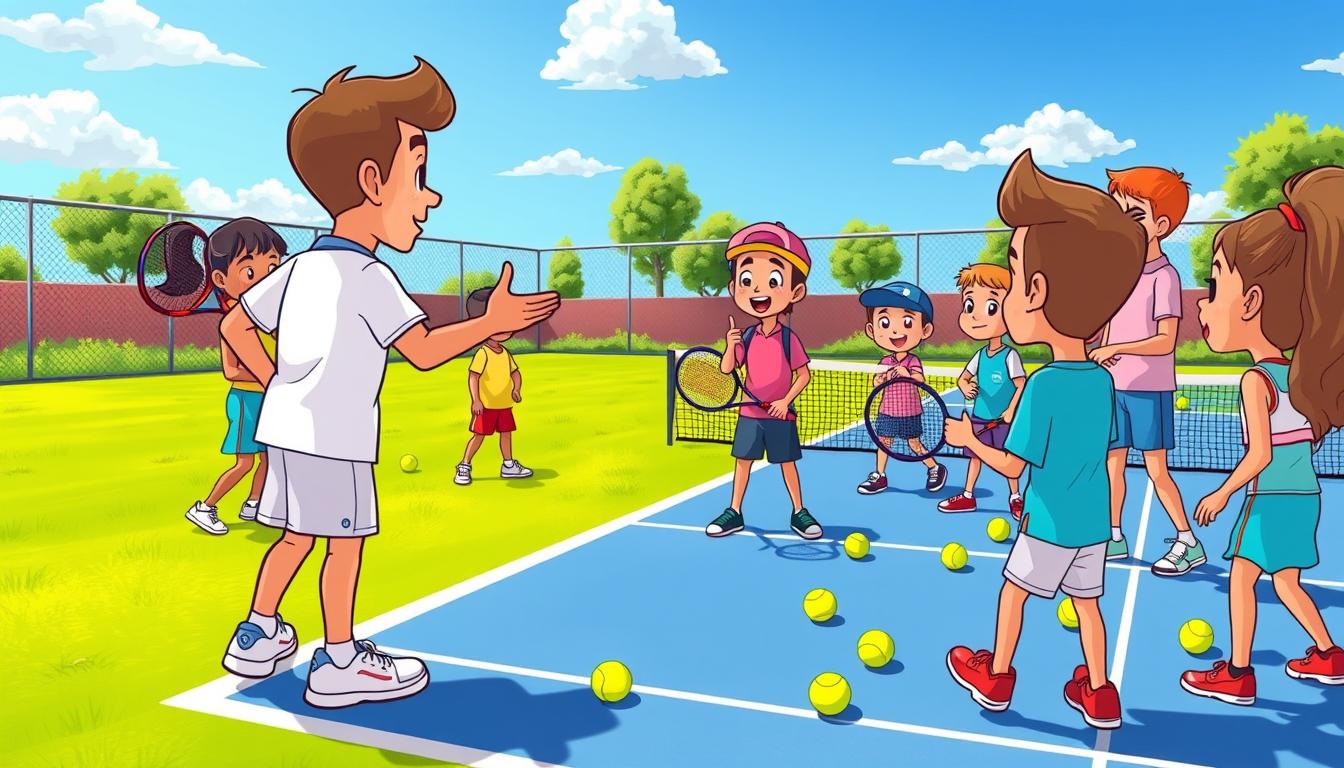
Tennis is an exciting and fast game where two players hit a ball over a net. If you want to start with beginner tennis lessons, or need a tennis starter guide, this article is for you. It will help you begin your tennis journey.
Key Takeaways
- Tennis is a fun and social activity that can be enjoyed by players of all skill levels.
- You’ll need basic equipment like a tennis racket and tennis balls to get started.
- The objective is to hit the ball over the net in such a way that your opponent cannot return it.
- Tennis can be a great way to stay active and improve your fitness.
- There are many options for beginner tennis lessons and courses to help you develop your skills.
Essential Tennis Equipment for Beginners
Starting your tennis journey means having the right gear. You’ll need a tennis racket and balls. Look for a racket with a big head, between 95-110 square inches. This size helps you hit the ball better.
Also, pick a racket with a grip that feels right in your hand. This ensures comfort while playing.
Tennis balls come in different types. Beginners should use coloured balls like red, orange, or green. These balls are softer and slower, helping you learn faster.
They make it easier to hit the ball and have longer games. This lets you build your skills and confidence.
| Tennis Equipment | Recommended for Beginners |
|---|---|
| Racket | Large head size (95-110 sq. in.), Comfortable grip |
| Tennis Balls | Coloured balls (red, orange, green) – slower, softer, lighter |
As you get better, you might want more gear. But for now, focus on a good racket and the right balls. This will help you enjoy your tennis journey.
Importance of Tennis Classes
Watching online tutorials and practising alone can help, but the best way to get better at tennis as a beginner is to join structured classes. These classes offer personal feedback and guidance from a certified coach. You won’t get this by learning alone.
The coach can spot areas for improvement and give you simple tips. Tennis classes break down the game into easy steps. This helps you build a strong foundation in tennis.
Simple Tips for Overwhelming Moments
Learning a new sport can be tough, but with the right support, you can overcome any challenges. Here are some tips to keep you motivated and focused in your tennis classes:
- Enjoy the learning process and celebrate small wins. Learning a new skill takes time, so be patient.
- Focus on your own progress, not comparing to others. Everyone learns at their own pace.
- Talk to your coach about any problems or frustrations. They can offer specific solutions to help you.
- Practice regularly, both in classes and on your own. Regular practice helps improve your skills.
- Keep a positive attitude and have fun! Tennis offers physical and mental benefits. Enjoy the journey and the company of your classmates.
By embracing the benefits of tennis classes and following these tips, you’ll become a confident and skilled tennis player. It doesn’t matter where you start.
“Tennis has a lot of elements that are universal across the globe. It’s a great sport for people of all ages to learn and pick up. And it’s great exercise – tennis requires a lot of physical agility, hand-eye coordination, and cardiovascular conditioning. It’s a perfect sport for improving your overall fitness and health.”
Tennis Court Geography
For beginners, knowing the layout of a tennis court is key. The tennis court layout for beginners is symmetrical. It has doubles sidelines for four players and singles for two. The baseline, 36 feet from the net, is where serves start.
The service line marks the deuce and advantage service boxes. Serves must land in these areas. Any ball touching a line is “in”, so it’s better to call balls near the tennis court lines as good.
The centre mark splits the court, dividing the forehand and backhand sides. Learning to keep score in tennis might seem hard at first. But with some practice, you’ll soon be a pro at it.
Keeping Score
Scoring in tennis is simple once you get it. Points are counted as 15, 30, 40, and a “game” is won at 40. The first to win 6 games in a set wins that set.
The first to win the majority of sets (usually best-of-three or best-of-five) wins the match.
Understanding Court Lines
The tennis court dimensions include the baseline, service line, centre mark, and sidelines. These lines and markings are key for knowing where to serve and hit shots. They also help with making line calls during the game.
Getting to know the court layout will help you play better as a beginner.
“Tennis is a physically demanding sport that requires practice and coaching for recreational success. It’s important for beginners to focus on developing basic skills before attempting advanced techniques.”
Solo Practice: Wall Drills for Beginners
Struggling to find a tennis partner? Hitting against a wall is a great, affordable option. Wall drills help you work on your strokes and improve your technique. You can also join local tennis groups or online communities to meet other players.
These groups often offer free or low-cost practice sessions. Playing with different partners can be motivating and help you improve. It’s a great way to build camaraderie and improve together.
Here are some effective wall drill exercises for your solo practice:
- Mini Court Tennis: Create a small court and practice forehand and backhand shots. Do 2 sets of 30 reps, 2 times a week.
- Ground Strokes Rally Ball: Practice forehand and backhand shots in sets of 25 reps. Do this 2 times a week.
- Heavy Topspin Lob: Focus on forehand and backhand shots in sets of 20 reps. Practice 2 times a week.
- Volleys: Practice forehand and backhand volleys in sets of 30 reps. Do this 2 times a week.
- First Volleys: Work on forehand and backhand first volleys in sets of 25 reps. Practice 2 times a week.
- Backhand Slice: Practice forehand and backhand sliced shots in sets of 30 reps. Do this 2 times a week.
- Reflex Volley Drill: Focus on forehand and backhand reflex volleys in sets of 35 reps. Practice 2 times a week.
- Racket Head Speed: Practice forehand and backhand shots in sets of 10 reps. Do this 2 times a week.
Regular practice of these drills can improve your tennis skills, even without a partner. Focus on technique, footwork, and shot execution to get the most from your practice.
How to play tennis for beginners: Basic Rules
Starting your tennis journey means learning the game’s basics. The key rule is that the ball must bounce once on each side of the net before being hit back. This is called the ‘bouncing basics’. Also, if the ball touches the court lines, it’s a valid shot.
When serving, you get two chances. Always say the score before you serve. This rule helps everyone know what’s happening.
Court Etiquette
Knowing the court rules is as important as the game itself. Always ask before crossing an active court. Also, shout ‘ball coming’ if the ball goes off court. These rules keep the game friendly and fun for everyone.
Learning the tennis rules for beginners, tennis court etiquette, and tennis basics for starters will help you start playing tennis confidently. You’ll enjoy the game more.
“Tennis is a game of chess, not checkers. The chess pieces are the players’ legs, and the board is the tennis court.”
Mastering the Forehand
The forehand is a key shot in tennis, making up over 70% of your strokes. To get better at it, work on a solid grip, smooth racket movement, and good ball contact.
Grip, Movement, and Contact
Begin with an Eastern grip for a stable base. Keep your racket low when taking it back. Aim to hit the ball over the net at about 6 feet high.
Stay in good body position, with your hips parallel to the net. Time your swing right to hit the ball in front of you.
Body Positioning and Timing
Practice regularly and pay attention to detail. Focus on reliable shots to improve your forehand. Remember, the forehand is often the first shot learned in tennis.
To hit a good forehand, remember these tips:
- Positioning or stance
- Backswing
- Forward swing and contact with the ball
- Follow-through
Most players make a common mistake: poor positioning. Beginners should use the Eastern grip. Semi-western and Western grips are better for high-bounce courts. Use the Continental grip on grass courts.
| Grip Type | Recommended Court Surfaces |
|---|---|
| Eastern Grip | Beginners |
| Semi-Western and Western Grips | High-Bouncing Courts |
| Continental Grip | Low-Bounce Courts (Grass) |
Regular practice, attention to detail, and focusing on reliable shots will make your forehand a game-changer.

Serving Essentials
Learning to serve well is key in tennis. The serve is the only shot where you control everything. So, it’s vital to have a reliable tennis serving technique. Start by holding two tennis balls and practice your toss until it feels right. Always say your score before serving, as the server does.
Work on a smooth swing, aiming for the opponent’s service box. If your first serve goes wrong, you get a second chance. But, two mistakes in a row means your opponent scores. Regular practice will improve your serve, making it a strong part of your game.
- Hold two tennis balls, not just one, and take as many ball tosses as needed to find your comfortable toss.
- Always announce your score first before serving, as the server always calls out the score.
- Focus on a smooth, controlled swing, aiming to hit the ball diagonally into the opponent’s service box.
- If you fault on your first serve, you’re allowed one do-over, but two faults in a row will result in a point awarded to your opponent.
- Consistent practice and attention to the fundamentals of the tennis serve techniques will help you develop this essential weapon in your tennis game.
“The serve is the most important shot in tennis. It’s the only shot where you have complete control.”
Getting good at serving is key for success in tennis. By mastering the basics and practicing, you’ll improve your serve. This will take your game to the next level.
| Skill | Description | Importance |
|---|---|---|
| Ball Toss | Ensuring a consistent and comfortable ball toss is essential for a reliable serve. | The ball toss sets the foundation for the entire serving motion, so getting it right is critical. |
| Swing Mechanics | Focusing on a smooth, controlled swing with proper form is key for serving accuracy and power. | Good swing mechanics lead to consistent and effective serves. |
| Serve Placement | Aiming to hit the ball diagonally into the opponent’s service box is the goal for a successful serve. | Targeting the correct service box makes it harder for your opponent to return the serve. |
Rallying and Volleying
In tennis, there are two main types of shots: rallies and volleys. Rallies are when you and your opponent hit the ball back and forth. The ball bounces on the court before you hit it back. These shots are hit from behind the baseline and are key to your game.
Volleys are shots hit without the ball bouncing. They are done at the net and aim to end the point quickly. They are powerful when done right.
Differentiate Rally and Volley
Knowing the difference between rallies and volleys is important. It helps you play better and adapt to different situations. Here are three tips to improve your rallying skills:
- Hit the ball at waist height, in front of your body, and to the side. This keeps your swing consistent and the ball in play.
- Get your racket back quickly to prepare for your shots. This helps you time your shots better.
- Stand further back behind the baseline to conserve energy. This also gives you more time to react to the ball.
Standing further back helps you avoid moving back and forth too much. This saves your energy. Focus on the second bounce of the ball to hit it at a better height.
| Rallying | Volleying |
|---|---|
| Groundstrokes hit from behind the baseline, allowing the ball to bounce before returning it. | Shots hit out of the air, without allowing the ball to bounce, executed at the net. |
| Smooth exchange of shots, the foundation of baseline play. | Game-changing shots meant to end the point quickly. |
| Requires consistent swing and timing to keep the ball in play. | Requires precision and control to finish the point. |
Being good at both rallying and volleying makes your game versatile. Use these tips to get better at tennis rallies for beginners and tennis volleys for beginners.

Conclusion
Your journey in learning tennis has been filled with valuable insights and essential skills. You’ve mastered the necessary equipment and the court’s geography. You’ve also learned the basic rules and foundational strokes like the forehand and serve.
Remember, the keys to improvement are consistent practice, a willingness to learn, and seeking guidance. Experienced coaches or players can help a lot.
As you continue to refine your skills, you’ll find tennis offers a lifetime of learning and enjoyment. Stay dedicated, have fun, and embrace the challenges. The tennis community is welcoming, and your commitment will be rewarded as you progress.
Tennis provides a versatile and rewarding experience for beginners. Whether you’re aiming to reduce stress, enhance your fitness, or simply enjoy the sport, tennis is great. By following the tips and strategies outlined in this guide, you’ll be well on your way to mastering the fundamentals and embarking on an exciting tennis journey.
Keep practising, stay patient, and enjoy the process of becoming a more confident and skilled tennis player.
One response to “Learn How to Play Tennis for Beginners”
[…] Learn How to Play Tennis for Beginners […]