

As an Amazon Associate, Tennis Blog earns from qualifying purchases. The links below are affiliate links, they cost you nothing extra.
Recommended on Amazon
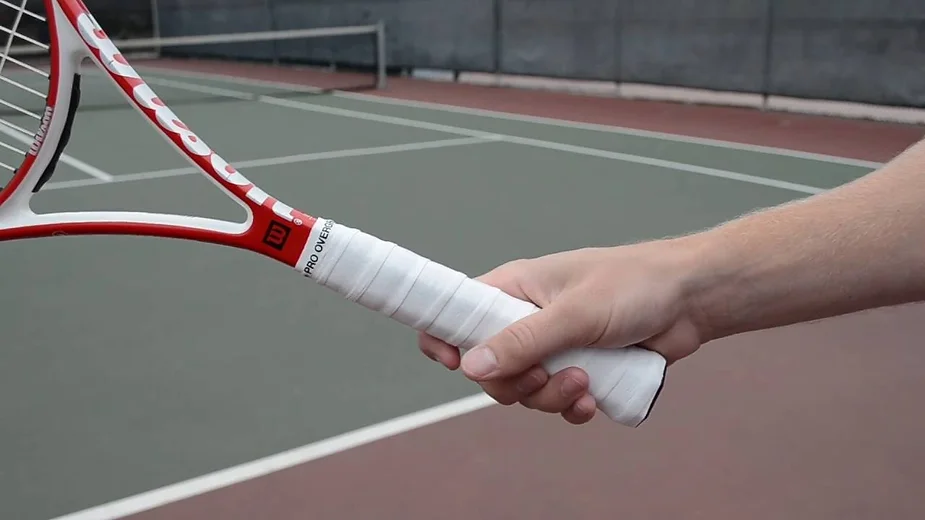
Changing how you hold a tennis racket can affect how the racket meets the ball. Most players have a standard grip for forehands, based on their skills. But, for serves, volleys, smashes, and slices, a flatter grip is better.
Both grips can be flipped for backhands. The two-handed backhand has its own special grip. Moving your hand around the racket handle helps you learn these grips.

Key Takeaways
- The continental grip is recommended for serving, volleying, smashing, and slicing.
- The eastern grip allows for slight spin and relatively flat shots.
- The semi-western grip generates more spin and weight of shot.
- The full western grip is used for clay-court play to generate a lot of racket speed and spin.
- The one-handed backhand grip usually sticks around the eastern grip.
Introduction to Tennis Grip Techniques
Learning the right tennis grip is key to the game. It affects how well you control the ball and place your shots. The grip you use can change how powerful, spun, and accurate your shots are. We’ll look at why grip awareness is important and how it can improve your tennis skills.
Importance of Proper Grip for Ball Control
The grip you choose is more than just how to hold a racket. It’s about feeling the racket face’s angle in your hand and seeing it as you hit the ball. Without grip awareness, controlling the ball’s path can be tough, leading to unpredictable shots.
About 70% of tennis shots are forehands. So, having a good forehand grip is key. The continental grip is great for many shots, like volleys and serves. It helps you keep the racket face open, which is important for precise ball control.
As players get better, they often switch from the eastern to the semi-western grip for topspin shots. This change can make your groundstrokes more aggressive and spinny. Being able to switch grips smoothly can greatly improve your ball control and shot-making.
To really get better at tennis, knowing the right grip isn’t enough. You need to feel the grip and the racket angle. You also need to develop muscle memory for precise shots. With regular practice and drills, you can improve your grip awareness and reach your full court performance.
“The grip you use is one of the most important factors in your tennis game. It determines your ability to control the ball and produce the shots you want.”
The Continental Grip
The continental grip, also known as the flat grip, is key in tennis. It lets you hit various shots, like serves, volleys, and slices. Learning this grip is vital for any tennis player.
To get the continental grip right, place your hand on the racket. The V made by your thumb and forefinger should be at 11 o’clock (or 1 o’clock for left-handers). This grip helps you hit shots with precision and control.
- The continental grip is a basic skill for beginners to learn.
- It helps you power up serves and return shots, including slices and kick serves.
- When volleying, this grip gives you control. You can hit hard or soft shots.
- To slice the ball well, turn your shoulders fully, keep the racket face open, and hit through the ball for backspin.
Getting good at the continental grip is key for a balanced tennis game. It’s useful for serving, volleying, and slicing. This grip helps you control the game and adapt to different situations.
“The continental grip is the foundation upon which all other tennis grips are built. Mastering this fundamental technique is essential for developing a strong, adaptable game.”
The Eastern Forehand Grip
Starting with the eastern forehand grip is a smart move for a well-rounded tennis game. It’s a classic, dating back to the 1920s. Top players like Roger Federer have used it. This grip lets you hit the ball flat or with a bit of topspin.
To use the eastern forehand grip, turn your hand clockwise. Place the thumb-finger ‘V’ between the 12 and 1 o’clock on the racket. This grip is relaxed, like a handshake. It helps the racket accelerate up the ball, giving it a slight spin.
The eastern forehand grip has its perks. It’s great for aggressive tennis and quick movements. It works well on grass courts, where the flat swing is effective.
But, it has its downsides. It’s harder to get lots of topspin. This might make your shots less powerful and more likely to miss. It can also struggle with high-bouncing balls on clay courts.
Despite these challenges, the eastern forehand grip is a solid choice for beginners. It’s natural and versatile. It’s a good base for building your tennis skills.
“The eastern forehand grip is a great choice for players seeking a natural, all-court approach to the game.”
How to hold a tennis racket: The Semi-Western Grip
The Game-Changing Grip for Topspin
In the world of tennis, the semi-western grip is a big deal. It helps players create more topspin and control. Many top players use it because it balances power and spin well.
The grip is known for the “V” shape made by your thumb and forefinger. It’s placed between the two and three o’clock on the racket. This lets you brush the ball up, adding lots of spin generation.
This grip is great for handling high balls and short topspin shots. You hit the ball between your waist and shoulder. This makes the topspin needed in modern tennis easier to achieve.
Switching from a continental grip to semi-western might take some getting used to. But the benefits are worth it. With time, you’ll find it easier, and it will give you more control.
Using the semi-western grip can really improve your game. It helps with spin generation and ball control. Learning this grip can make your tennis more versatile and effective.
The Western Grip
The western forehand grip is loved by top tennis players like Kei Nishikori and Kyle Edmund. It forms an octagonal shape on the racket. This grip is used by a few pros but helps them hit the ball with lots of topspin.
This grip makes it easier to control powerful shots. It also makes the ball jump up sharply after it bounces. This is great on clay courts and other high-bounce surfaces.
The western grip is good for handling high-bouncing balls. But, it can be hard to switch to lower balls and do volleys well. The distance between the western and continental grips can be a problem.
Starting with the western grip can be tricky for beginners. It can strain the wrist and forearm if not used right. It’s better to begin with a more flexible grip, like the semi-western, before trying the western grip.
Despite its challenges, the western grip is popular among clay court players. It helps them hit the ball with extreme topspin. Learning this grip takes time and practice, but it can be a powerful tool for tennis players.
Backhand Grips
Mastering the backhand grip is key in tennis. Whether you prefer a one-handed backhand or a two-handed backhand, knowing how to hold the racket is vital. It affects your control and how well you hit the ball.
One-Handed and Two-Handed Techniques
To switch from a forehand grip to a one-handed backhand, use the “clock principle”. Start with a continental grip and then move your hand a few notches anti-clockwise. This depends on the spin you want. Most one-handed players use an eastern backhand grip for balance and power.
The two-handed backhand is like hitting a forehand with your non-dominant hand. The left hand (for right-handed players) takes the lead, using an eastern forehand grip higher up. The right hand has a neutral continental grip for support.
“Learning to gain control in the non-dominant arm is emphasised for proper execution of the two-handed backhand.”
Beginners should prepare the racket backwards with little wrist movement. Then swing it forward, using power from the non-dominant hand. Keeping the hands close is key to avoid losing control.


Choosing between a one-handed or two-handed backhand, practice is essential. Understanding the backhand grip mechanics will make your stroke reliable and effective.
Mastering the Transition Between Grips
Learning to switch between grip techniques is key for tennis players. Many make the mistake of not moving the racket to their non-dominant hand for a grip change. This often keeps them in the grip of their most hit shot, usually the forehand, leading to backhand issues.
To fix this, touch your non-racket hand to your throat after every forehand shot. With practice, your non-dominant hand will handle the racket’s weight. This lets your dominant hand move freely to pick the best grip for the next shot.
Getting good at switching grips boosts your game, lowers injury risk, and improves your play. By adding this to your practice, you’ll smoothly switch grips. This lets you play a wider range of shots with better control and precision.
“Players using the incorrect grip could be losing about 50% of the power, spin & control they could be getting.”
The secret to a good grip transition is your non-dominant hand. Always bring the racket back to this hand. This lets you adjust your grip and meet the game’s changing needs.
Drills to Improve Grip Awareness
- Practice the grip transition between forehand and backhand strokes, focusing on smooth hand movement.
- Try different grip changes in your practice, like switching from a continental to an eastern grip for forehand groundstrokes.
- Do racket hand placement drills, paying close attention to your hands’ position on the handle.
- Try forehand to backhand transition drills, smoothly switching grips as you move across the court.
By spending time on these drills, you’ll get better at grip awareness and switching. This will take your tennis game to the next level.
Feeling the Grip and Racket Angle
Mastering the art of holding a tennis racket is key for better ball control and consistent shots. Many players struggle because they see the racket handle as a round object, like a bat. This makes it hard for them to grasp the racket’s flat face and its exact position in space.
Drills to Improve Grip Awareness
Drills can help players get a clear mental and physical feel for the racket’s orientation. These exercises involve placing the hand on the strings, then the throat, and lastly the handle. This helps players build a better sense of the racket’s shape and angle.
By doing these drills, players can improve their grip feel, racket angle, and hand-racket alignment. These are key for better ball control and consistent shots.
| Drill | Purpose |
|---|---|
| Grip Awareness Drill | Helps players develop a clear mental image and tactile feel for the racket’s orientation. |
| Racket Angle Drill | Enhances players’ understanding of the racket’s alignment in their hand, which is vital for ball control. |
| Hand-Racket Alignment Drill | Helps players develop a seamless connection between their hand and the racket, improving overall technique. |
By adding these grip drills to their training, players can feel the racket more intuitively. This leads to better ball control and a more consistent, powerful, and precise game.
Conclusion
Learning the different tennis grips is key to improving your game. Each grip has its own purpose and feel. This lets you adjust your technique for various shots, like serves and volleys.
Practicing how the racket feels in your hand is important. It helps you hit the ball more cleanly and consistently. This can take your tennis skills to new levels.
Choosing the right grip, whether it’s Eastern, Continental, or Western, is vital. It’s essential for better shot improvement and ball control. Adjusting your grip and racket angle can boost your power, spin, and precision.
Keep trying out different grip techniques. Experiment to find what works best for you. With regular practice and attention to detail, you’ll become a more confident tennis player. You’ll be able to play a wide range of shots with ease and control.
FAQ
What is the importance of proper grip for ball control in tennis?
The grip on your tennis racket changes how it meets the ball. It’s key for controlling the ball and making consistent shots. It lets you feel and see the racket’s angle in your hand.
What is the continental grip and how is it used?
The continental grip is the basic grip. Place your hand so the V between your thumb and forefinger is at 11 o’clock. It’s used for serving, volleying, and smacking the ball.
How does the eastern forehand grip differ from the continental grip?
The eastern grip is like a handshake with the racket. The V is between 12 and one o’clock. It helps the ball spin slightly, keeping it flat.
What is the semi-western grip and how does it help generate topspin?
The semi-western grip is between two and three o’clock. It’s great for modern tennis, aiming for spin and weight. It lets you hit the ball up and add spin.
How do one-handed and two-handed backhand grips differ?
One-handed backhands use a grip similar to the forehand. Most stick to an eastern grip. Two-handed backhands have the left hand in an eastern grip and the right in a continental grip.
Why is it important to change grips between different shots?
Changing grips is key, but many players don’t do it well. They often stick to the forehand grip, causing backhand issues. Touching the racket throat with your non-racket hand helps with smooth transitions.
How can players develop a better feel for the racket grip and angle?
Drills like touching the strings, then the throat, and the handle help. They improve your mental image and feel for the racket’s angle. This is vital for controlling the ball and making consistent shots.
One response to “How to Hold a Tennis Racket: Proper Grip Techniques”
[…] How to Hold a Tennis Racket: Proper Grip Techniques […]